
As large language models (LLMs) become increasingly central to applications across industries, the challenge shifts from simply building and deploying these models to making them production-ready. The path from prompt engineering to system design is lined with obstacles like hallucination, scaling, latency, and cost. Here, we explore how to navigate these challenges to create robust LLM-based systems.
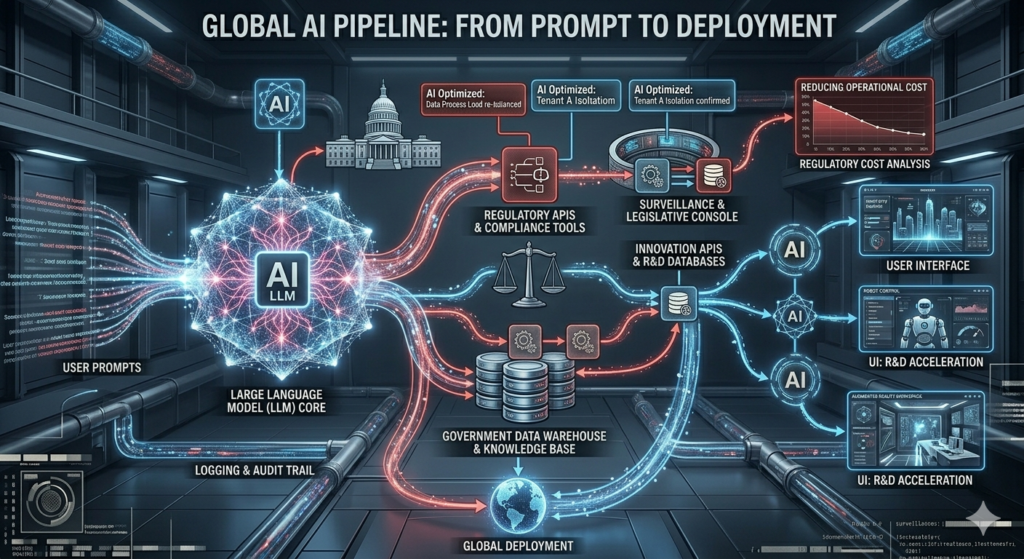
Understanding LLM Behavior in Production Systems
Production systems harnessing LLMs require careful design to manage unique model behaviors. While prompt engineering allows for crafting specific interactions with the model, several real-world complexities must be addressed.
From Theory to Practice: Effective Prompt Engineering
Prompt engineering focuses on optimizing inputs to guide model outputs. In practice, this involves iterative testing and refinement to minimize issues like model hallucination, where the output may contain fabricated information.
- Iterate on prompts to refine output consistency.
- Utilize context anchoring to improve relevance.
- Apply temperature settings to adjust response creativity versus determinism.
“Prompt engineering is both an art and a science, demanding structured experiments to unlock consistent, reliable LLM outputs.”
Flow of a Typical LLM System
Data Ingestion → Preprocessing → Embedding / Feature Engineering → Model Training → Evaluation → Inference → Monitoring
System Design for Scalability and Reliability
Moving beyond prompt engineering, the architecture of an LLM system must be crafted for scalability and resilience. Design considerations include balancing computational resources, data pipelines, and integration with existing systems.
Data Considerations
Data is the lifeblood of LLM systems, influencing both performance and scalability.
A crucial aspect is the need for continuous monitoring to identify drift in input patterns or performance over time, enabling timely model updates and retraining.
Balancing Cost and Performance
| Approach | Strength | Tradeoff |
|---|---|---|
| RAG | Grounded responses | Retrieval complexity |
| Distillation | Cost efficiency | Possible accuracy loss |
Approaches like Retrieval-Augmented Generation (RAG) provide grounded outputs but come with computational overhead. Model distillation offers reduced costs but may sacrifice some accuracy. Choosing the right architecture depends heavily on specific use cases and resource availability.
Latency and Deployment Challenges
In production environments, latency can significantly impact user experience. Efficient model deployment and response times are crucial for maintaining performance standards.
Optimizing Inference
To address latency, consider leveraging optimized hardware, such as GPUs or TPUs, and applying inference optimization techniques, e.g., quantization.
Real-World Example: Chatbot System
Consider a customer support chatbot that taps into an LLM for generating responses. Integrating a RAG approach enables the system to pull real-time data, ensuring responses are relevant and grounded in fact.
def get_response(prompt): context = retrieve_relevant_data(prompt) return model.generate(prompt + context)Advanced Topics: Model Limitations and Ethical Considerations
While designing sophisticated LLM applications, understanding model limitations and ethical considerations is imperative. Potential biases within models can reflect on application outputs, requiring rigorous fairness assessments.
Model interpretability remains a challenge, urging continuous research and development to ensure transparent AI systems that can explain decision pathways and model reasoning.
Building production-ready LLM applications is a multifaceted endeavor that demands an integration of engineering precision and strategic oversight. By merging prompt engineering with holistic system design, we pave the way towards robust, impactful LLM deployments.
In conclusion, the journey from intent realization through LLM prompts to comprehensive system architecture involves addressing computational challenges, aligning model behavior with system goals, and ensuring that the technology serves its users responsibly and effectively.