In the evolving landscape of Software as a Service (SaaS), designing scalable multi-tenant architectures presents unique challenges. With growing user bases and varying demands, architects must focus on balancing complexity with performance, ensuring reliability and maintaining secure data isolation across tenants.
Understanding Multi-Tenancy
Multi-tenancy is the architecture in which a single instance of software serves multiple tenants or customers. Each tenant’s data is isolated and remains invisible to others, yet the underlying resources are shared. Achieving this requires a detailed examination of design patterns that can support scalability while ensuring security and performance.
Architectural Patterns for Multi-Tenancy
Two common approaches to multi-tenancy include:
Database Per Tenant provides strong data isolation, allowing tenants to have dedicated instances. This approach, however, increases operational overhead and may limit scalability due to resource constraints.
Shared Database, Separate Schema is more resource-efficient with a single database supporting multiple schemas for tenants. It offers improved resource utilization but requires careful schema management and security considerations.
Reasoning Behind Multitenancy Choices
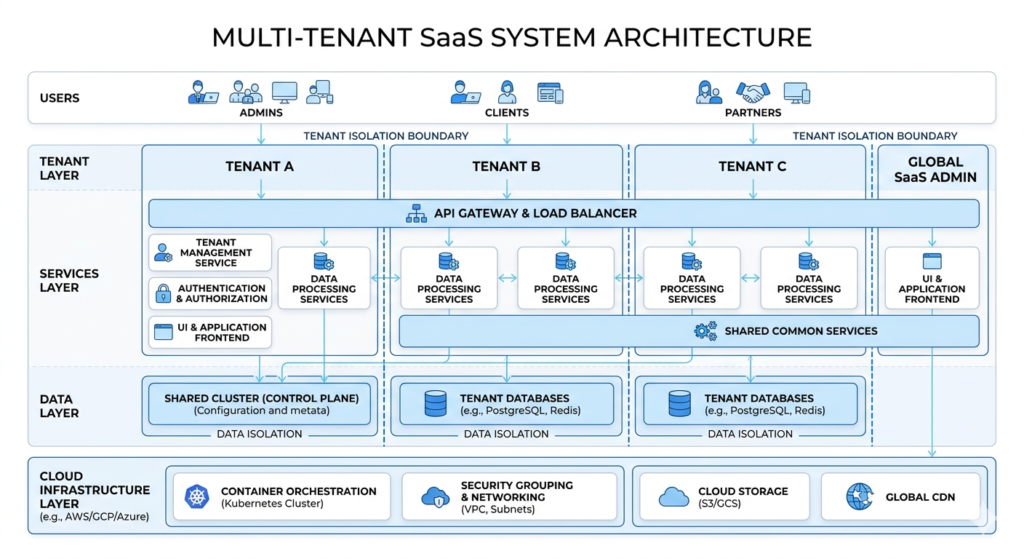
Deciding between these architectural patterns often involves tradeoffs in scalability and operational complexity. Key factors include:
- Scalability: Database-per-tenant can become resource-intensive as the number of tenants grows. Shared database solutions enhance scalability with better resource sharing.
- Isolation: Database-per-tenant offers better isolation naturally but incurs higher costs.
- Cost: Shared databases typically have lower infrastructure costs due to shared resources.
Examining the need for data partitioning becomes essential, especially when considering eventual consistency vs. strong consistency across distributed systems.
Scaling Strategies in SaaS
Scalable SaaS architectures often employ microservices to enhance flexibility and manage complex systems. Horizontal scaling, with services independently deployable, ensures that each component can scale out without impacting others.
“Scalability is about intelligent resource management, not just replication.”
Failure Isolation Patterns
Designing for resilience involves strategies to isolate failures and minimize impact. Circuit breakers and bulkheads are common patterns to enhance system robustness.
Data Consistency Models
In multi-tenant systems, ensuring data consistency is crucial. The choice between strong and eventual consistency models affects system design and user experience substantially.
Strong Consistency ensures that all nodes reflect the same data at any time, typically at the expense of higher latency.
Eventual Consistency allows for temporary discrepancies, often yielding increased performance and availability.
The CAP theorem guides these choices, illustrating the inherent tradeoffs between consistency, availability, and partition tolerance in distributed systems.
Comparative Overview
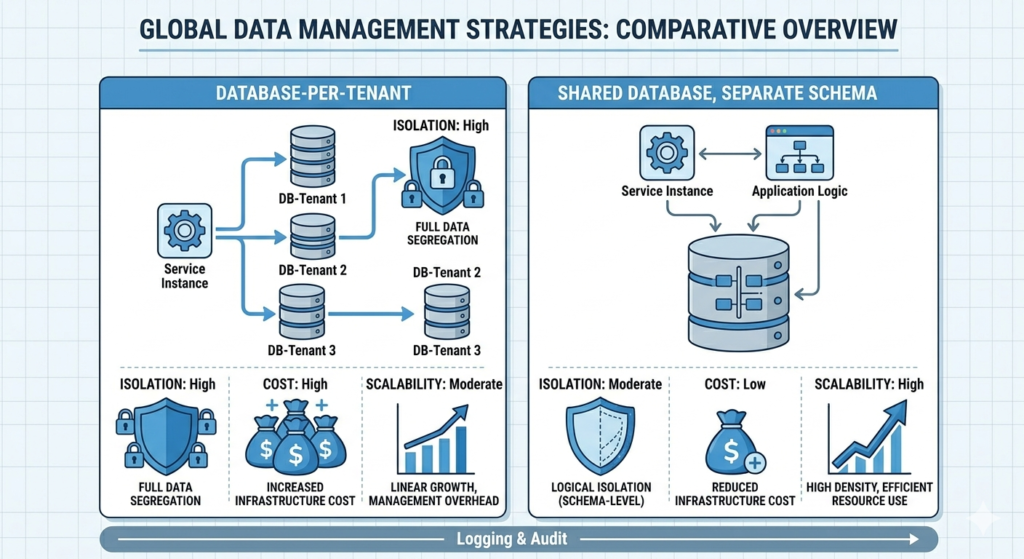
Below is a comparison of multi-tenancy strategies:
- Database-per-tenant
- Isolation: High
- Cost: High
- Scalability: Moderate
- Shared Database, Separate Schema
- Isolation: Moderate
- Cost: Low
- Scalability: High
Conclusion
Building a multi-tenant SaaS architecture requires a strategic balance between scalability, cost, and isolation. Modern approaches emphasize the use of shared resources, microservices, and robust consistency models to provide a scalable and efficient platform. By understanding and implementing failure isolation patterns and effective data consistency strategies, architects can design systems that are not only robust but also prepared for growth.